Why Delight Is Completely Different from Gamification

I get this question almost every time I speak about product delight: “Isn’t delight just another form of gamification?” The two concepts are often confused, but they serve very different purposes. Treating them as interchangeable can lead teams to design products that feel addictive instead of meaningful and manipulative instead of trustworthy.
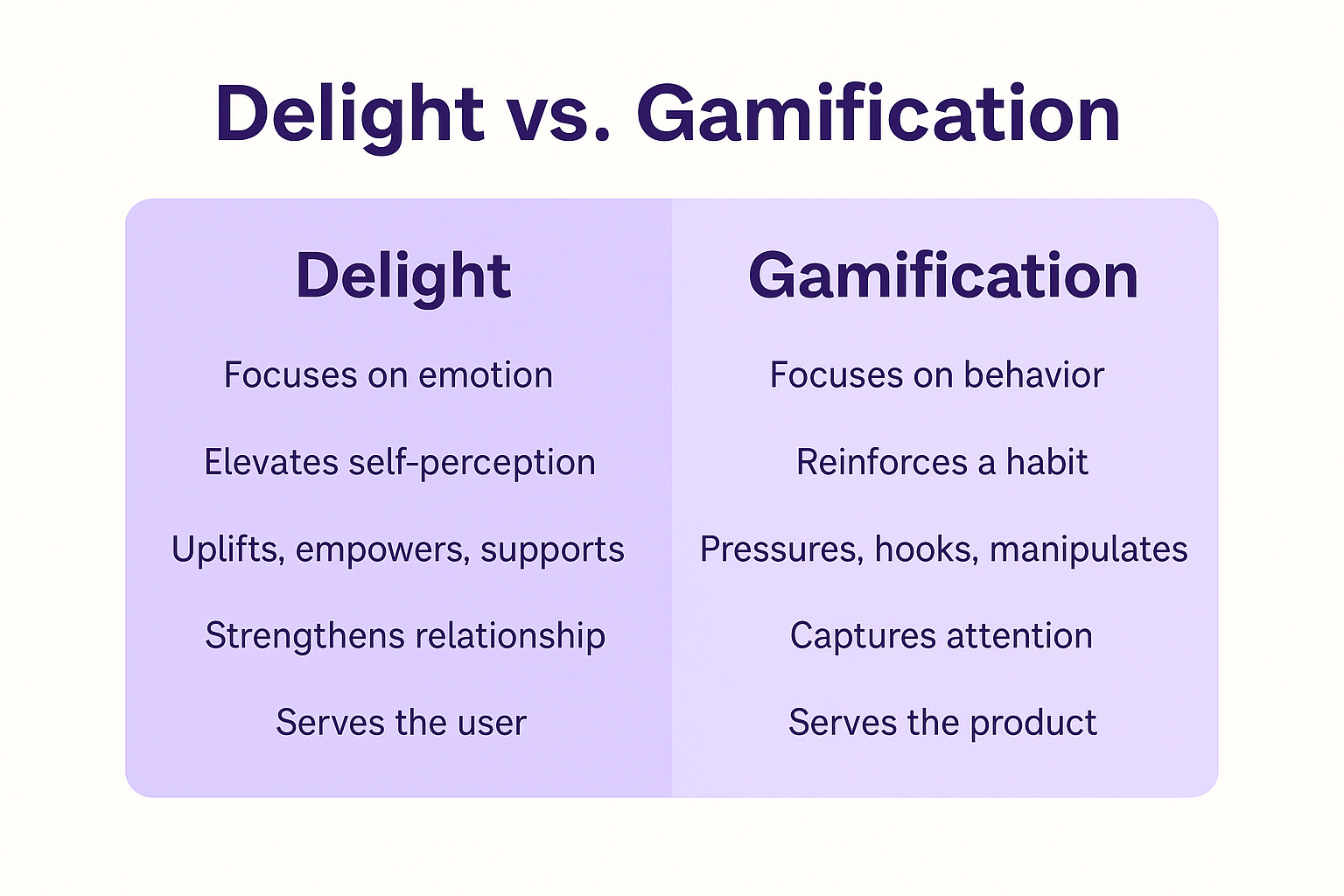
Gamification is fundamentally designed to influence behaviour. It pushes users to consume more, stay longer, or return more frequently. Features such as infinite scroll, streaks, badges, and daily rewards are not inherently harmful, but their primary purpose is to reinforce a habit. A classic example is snapstreaks: users keep sending messages not because they want to communicate something meaningful, but because the streak itself becomes the goal. Instagram’s endless feed is another example; the design optimises for attention, not wellbeing.

Delight begins from a different place entirely. It asks: How do we want our user to feel while using our product? It focuses on emotional quality rather than behavioural reinforcement. Instead of trying to keep users inside the experience as long as possible, delight tries to make users feel understood, supported, uplifted, or proud of themselves.
This distinction is not theoretical. When Marty Cagan reviewed an early draft of my book, Product Delight, he immediately raised a concern: delight must be discussed as an ethical concept, not as a hooking mechanism. He was right. A feature cannot be considered delightful if the user leaves the experience feeling worse about themselves.
“Strong product people have recognized that to get someone to actually choose and use your product, customers need to perceive real value. With some products, especially in the enterprise, just being able to reliably deliver the necessary functionality can be enough to earn you a very happy and devoted customer. But often, value requires more. For those products, we strive for our customers to feel real emotion for our products, such as delight, or even love. Nesrine’s book is not the first to tackle this important topic, but most of the earlier efforts took a shortcut. It’s not that hard to use techniques like gamification to make products that are addictive. But today we all know the ethical, cultural and environmental consequences of this lazy approach. For those that want to do better, Nesrine is trying to help you create meaningful delight.”
Marty Cagan
Silicon Valley Product Group
A simple example makes the contrast clear. Infinite scroll on TikTok or Instagram is a pure gamification mechanism. It is designed so that you never reach an end. Users often emerge from twenty minutes of scrolling feeling drained or guilty. Now imagine the opposite. If I get a notification reminding me that I need to stop scrolling and do a better use of my time, that’s a diffrent story. Such notification makes users feel that the product cares about their wellbeing. That feeling, of being looked after rather than exploited, is delight.
Delight also shows up in positive, meaningful moments created by products that understand the user deeply. In e-commerce, Amazon provides a subtle example of delight when it warns you that an item you bought often goes on sale and suggests waiting if you’re not in a hurry. The company temporarily sacrifices revenue to protect the user’s interest, and the result is trust. Contrast that with the gamified countdown timers on fast-fashion sites urging “Only 4 minutes left to buy at this price.” One creates comfort; the other creates stress.
Finance is another interesting space. Many banking apps use gamification—points, daily challenges, random rewards—to increase usage. But apps like Revolut or Lydia occasionally introduce delightful moments: for instance, telling a user that most of their spending this month went to local merchants or congratulating them for reaching a savings milestone before the end of the year. These moments elevate self-perception rather than pushing further consumption.

The easiest way to distinguish the two is to observe how the user feels when the interaction ends. If they feel pressured, guilty, or hooked, you are dealing with gamification. If they feel proud, reassured, empowered, or valued, you are experiencing delight.
Gamification tries to change a user’s behaviour. Delight tries to change a user’s emotional experience. One keeps people inside the product longer. The other builds a relationship that makes people want to come back because of how they feel about themselves when they do. Gamification can be useful when used responsibly, but delight is ethical by design. It reinforces trust, elevates identity, and generates emotional resonance.
And in a world saturated with attention-optimised experiences, the products that stand out are the ones that make users walk away feeling better about being who they are.